|
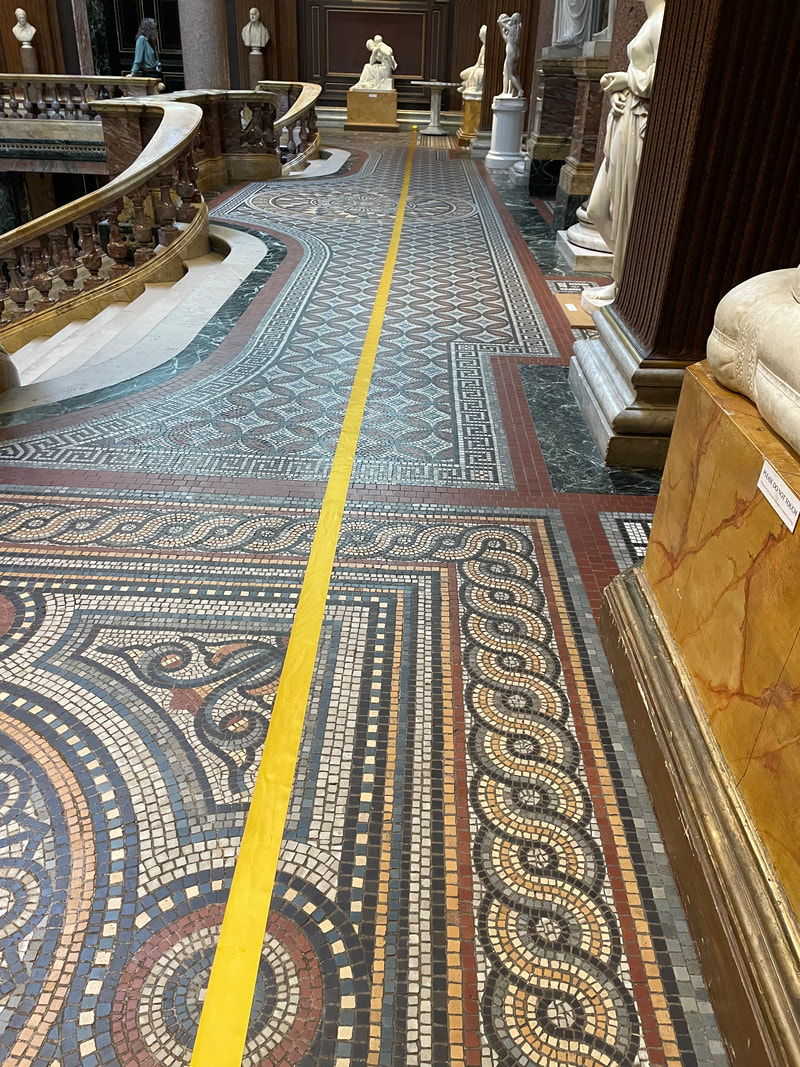
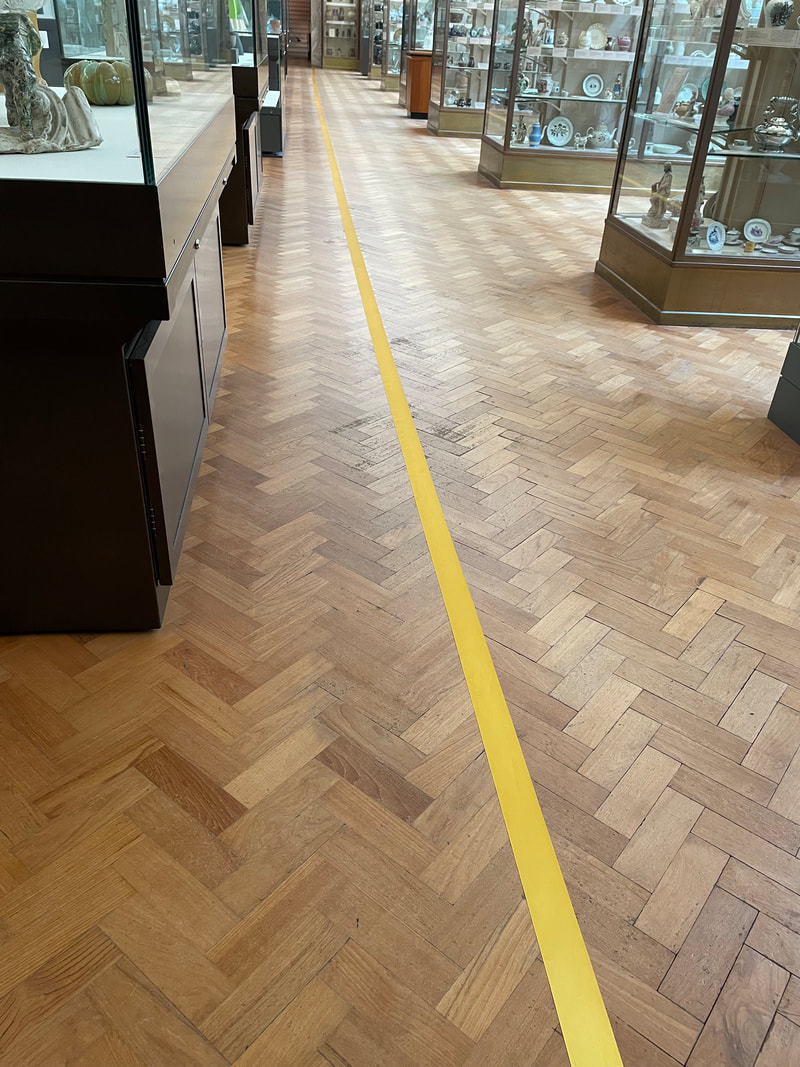
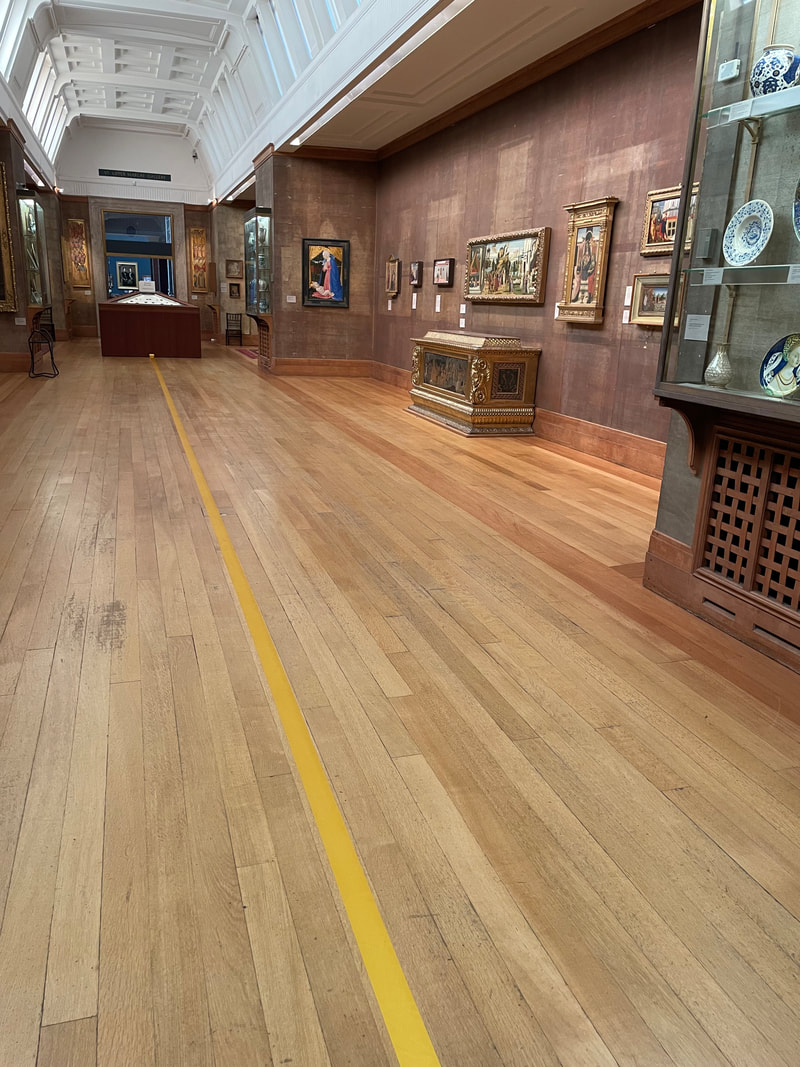
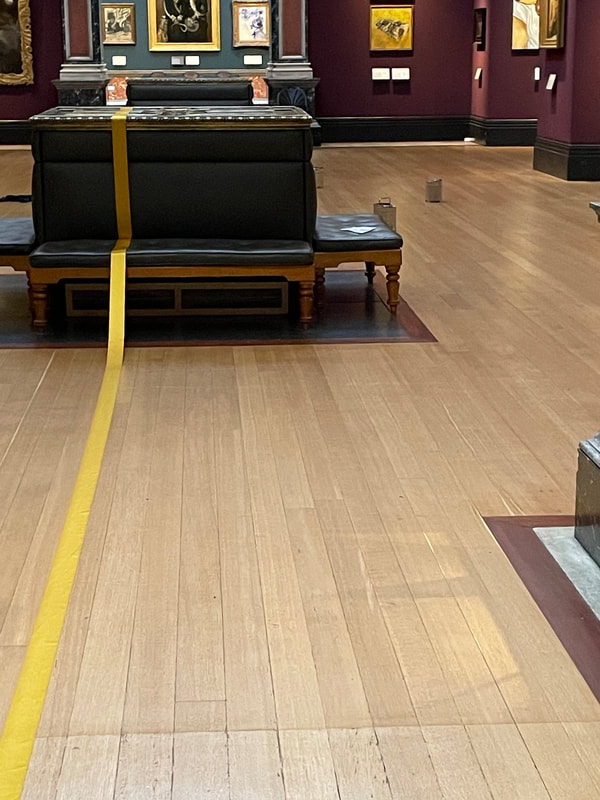
During my initial PhD research session at Tate Modern we rolled a yellow ribbon down the Turbine Hall- it made a temporary demarcation - a yellow line, a territorial claim, sliding across the surface of the institution that we were endeavouring to inhabit differently. At the Fitzwilliam I wanted to repeat this action, the ribbon again laying down a marker. It felt as though I had placed a flag into the soil of the building for a moment of ownership. The action whilst delicate in material feels powerful. In response to the action at Tate I had written the following:
'As the yellow satin line unfurled, more and more space seemed to be claimed by it. Lloyd’s action with the satin had appeared to split the space in two, as would a pencil being drawn down the length of a piece of paper. This simple act altered my attention to the materiality of the floor, and I noticed the scar of Doris Salcedo’s artwork ‘Shibboleth’ (2007) 38 zig-zagging its way down the space. Salcedo’s artwork had originally provided a crack through the concrete of the Turbine Hall, an action that had directly impacted the architecture of the space, the rupture questioning, extending, or breaking borders and altering it beyond the exhibited time of the work. The filled in crack was still present and a memory of the rupture Shibboleth had caused. The yellow ribbon followed alongside and was now set in dialogue with the trace of ‘Shibboleth’, a fault-line in the concrete. If Salcedo’s artwork had been a deliberate rupturing of the institutional space, what did the new and temporary yellow line afford?' https://www.tate.org.uk/art/artists/doris-salcedo-2695/doris-salcedo-shibboleth It was interesting to see that Salcedo’s work had directly cut into the institutional space of Tate and responded to territorial issues of power. In the text associated with the artwork Tate questions; ‘What might it mean to refer to such violence in a museum of modern art?’ At the Fitzwilliam, the multiple rolling felt as though I was gathering up the spaces - claiming one after another perhaps providing a new route or a new anchor between the exhibits and artefacts, a unifying delineation a pull. Garoian uses the word suture’ (2013, p.90) as a way of understanding the alternative connections that can emerge through a prosthetic pedagogy. Touching and intangible touching as well as other differing knowledges are sutured or stitched together within the art museum. Did the yellow ribbon, its line draw through, thread and suture the spaces and introduce a new gathering?
0 Comments
Leave a Reply. |
Dr. Kimberley FosterKimberley Foster is an artist and lecturer and a Cambridge Visual Culture Visiting Research Fellow. Her PhD practice research; Material Acts of Thinking and Learning in the Art Museum. Embodied Encounters and the Pedagogical Art Object focused on material engagements at Tate Modern and Sainsbury Centre UEA. She has a collaborative practice as sorhed (www.sorhed.com) and works extensively with exhibitions and collections. Kimberley is currently a PGR Supervisor for a CDP between Goldsmiths and the National Gallery and was previously Head of Programme for the MA in Arts and Learning at Goldsmiths. Archives
April 2025
Categories |
RSS Feed